On a whim today I purchased an additional 270 shares of TTT at $7.82. The more I think about TTT, the more I think it's like LUK - basically a company run by a shred/talented capital allocator who is focused on creating shareholder wealth by compounding book value. With these types of companies I'd prefer for the position size to be more than 10% of my portfolio, and with TTT spinning off one share of KHDHF for every 9 shares I wanted my position to be comfortably above the 10% threshold post spinoff.
On a side note this puts my cash position at only $23K, which feels low and makes me a little nervous given the markets recent run-up.
Monday, November 1, 2010
Wednesday, October 13, 2010
My Returns as of Oct. 12th 2010
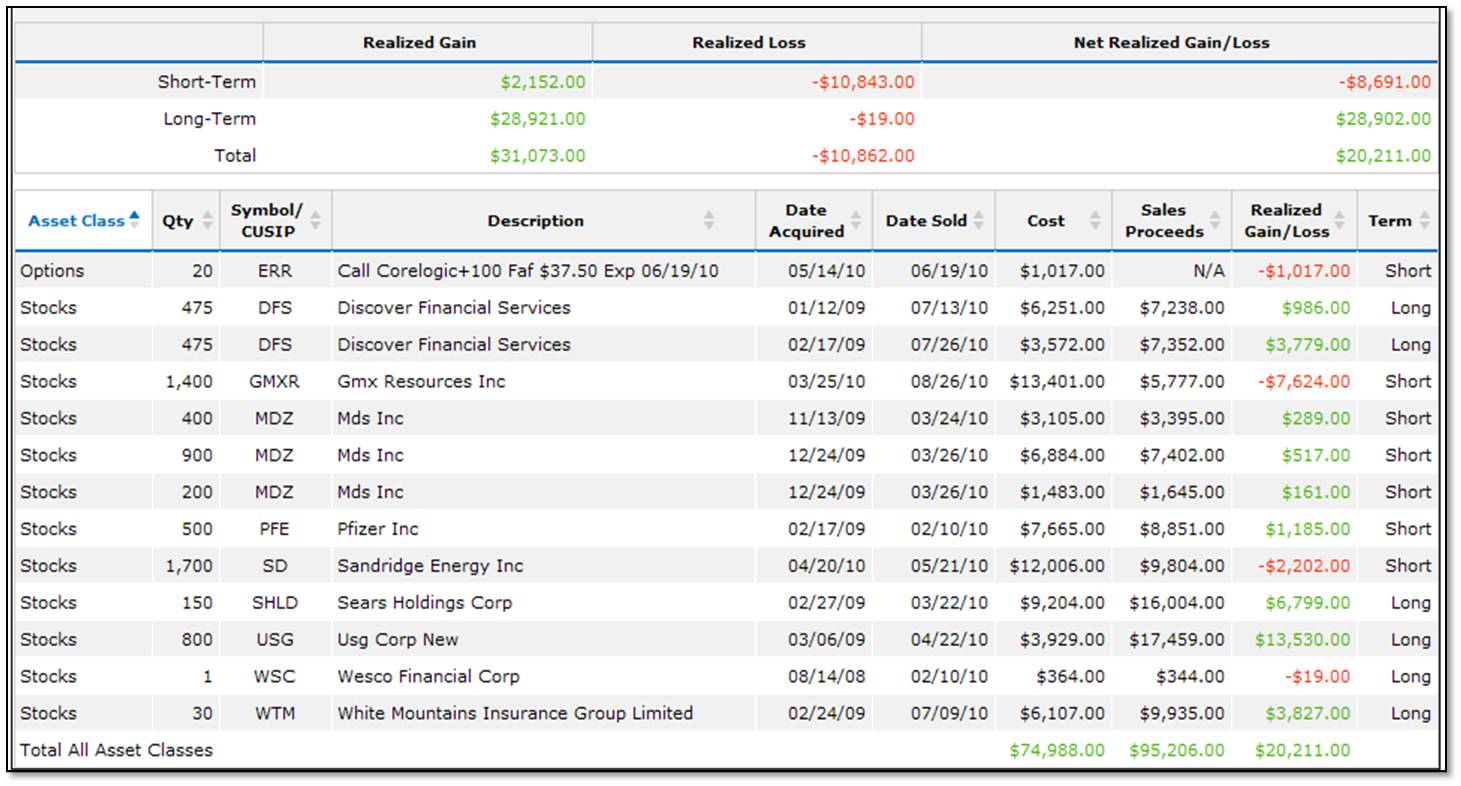
When I posted my returns at the end of Q3 one reader correctly pointed out that I wasn't showing my cost basis for each holding. At the time TradeKing was doing some sort of behind-the-scenes IT conversion and didn't display cost basis on their summary pages. They've since finished the conversion, so I thought I'd post a quick update on my returns and update the "My Returns So Far..." and "My Current Holdings" pages.
I started 2010 with $107,514 and as of 10/12/2010 my account balance is $108,885 (Note: as of Q3 when I last posted about my returns my balance was $104,494, so this is quite a jump in the last 2 weeks). YTD I haven't made any deposits or withdrawals, so the increase in value was driven by an aggregate increase in my holdings.


I started 2010 with $107,514 and as of 10/12/2010 my account balance is $108,885 (Note: as of Q3 when I last posted about my returns my balance was $104,494, so this is quite a jump in the last 2 weeks). YTD I haven't made any deposits or withdrawals, so the increase in value was driven by an aggregate increase in my holdings.
- On an absolute basis, my portfolio gained 1.3% YTD while the S&P (w/ dividends reinvested) is up 6.1%.
- I've been tracking my returns for 4 years and 9+ months, during which time my annual rate of return is 14.6%. Over the same period the S&P returned 2.3% annually. In other words, over the last 4 years and 9+ months I've outperformed the S&P by about 12% per annum.



Saturday, October 9, 2010
Some more thoughts on TTT/MCFAF
In my previous post on TTT/MCFAF (click on "zCurrent Holding: TTT" under Labels) I mentioned how the recently announced merger made TTT an attractive investment, so I thought I'd elaborate a little here...
MCFAF can be thought of as the original Michael Smith investment vehicle, and through countless mergers/acquisitions/divestitures/spinoffs it's been used to generate serious wealth over the last two decades. Before the merger I thought TTT was cheap, but I never bought it b/c I was worried about any conflicts of interest. Afterall, with Smith controlling both companies and with both companies dependant on acquisitions to create value, I was worried he would cherry-pick the best opportunities for MFCAF. Additionally, TTT was basically a mining royalty company that paid MFCAF a fee for administration - perhaps this fee was slightly beneficial to the shareholders of MFCAF at the expense of TTT? Lastly, from what I've been able to gather (from 3rd party sources, so I can't verify the accuracy), Michael Smith has a large ownership stake in MFCAF and a small stake in TTT, so financially he's much more aligned with MFCAF (and when I evaluate stocks, insider alignment is one of my primary considerations).
So, my next thought was why the merger and why now? Afterall, over the last 5-10 years Smith has gone through considerable lengths to put build the company that was basically the sum of TTT, MFCAF, and KHDHF*. He then spun out MFCAF and a few years later he split up TTT and KHDHF, and now he's merging TTT and MFCAF! Wouldn't it've been easier to just spin out KHDHF in the first place? Ultimately there's no way for me to know why Smith has made these transactions so complex, BUT that doesn't matter b/c with the TTT/MFCAF merger I'm comfortable that now I'm directly aligned with him.
So, all that being said, I do have a conspiracy theory about what might be up Smith's sleeve. Recently, TTT issued stock to raise cash for the express purpose of pursuing an acquisition. My blue-sky hope is Smith found an acquisition that's so attractive he, along with his MFCAF shareholders, wants a piece of the wealth it'll generate - and what better way to do this than by merging MFCAF into TTT before the acquisition becomes public? Also, this is consistant with a nuance of the TTT/MFCAF merger that has a lot of people scratching their heads - Smith is financially aligned with MFCAF, but on the surface the TTT/MFCAF merger appears to benefit TTT shareholders at the expense of MFCAF. Afterall, on a conference call Smith was very confident he has the necessary MFCAF shareholder support for the TTT merger - perhaps the pending acquisition was how he got it? Of course this is just IDLE SPECULATION on my part, we'll see what happens...
*KHDHF is a cement/industrial company that trades on the Frankfurt exchange and here in the US on the pink sheets. This company is being spun out of TTT in 4 phases, three of which are already complete. After TTT and MFCAF merge, I'll get 1 share of KHDHF for every 9 shares of TTT/MFCAF I own (which is why I purchased such an odd number of shares - it's divisible by 9).
MCFAF can be thought of as the original Michael Smith investment vehicle, and through countless mergers/acquisitions/divestitures/spinoffs it's been used to generate serious wealth over the last two decades. Before the merger I thought TTT was cheap, but I never bought it b/c I was worried about any conflicts of interest. Afterall, with Smith controlling both companies and with both companies dependant on acquisitions to create value, I was worried he would cherry-pick the best opportunities for MFCAF. Additionally, TTT was basically a mining royalty company that paid MFCAF a fee for administration - perhaps this fee was slightly beneficial to the shareholders of MFCAF at the expense of TTT? Lastly, from what I've been able to gather (from 3rd party sources, so I can't verify the accuracy), Michael Smith has a large ownership stake in MFCAF and a small stake in TTT, so financially he's much more aligned with MFCAF (and when I evaluate stocks, insider alignment is one of my primary considerations).
So, my next thought was why the merger and why now? Afterall, over the last 5-10 years Smith has gone through considerable lengths to put build the company that was basically the sum of TTT, MFCAF, and KHDHF*. He then spun out MFCAF and a few years later he split up TTT and KHDHF, and now he's merging TTT and MFCAF! Wouldn't it've been easier to just spin out KHDHF in the first place? Ultimately there's no way for me to know why Smith has made these transactions so complex, BUT that doesn't matter b/c with the TTT/MFCAF merger I'm comfortable that now I'm directly aligned with him.
So, all that being said, I do have a conspiracy theory about what might be up Smith's sleeve. Recently, TTT issued stock to raise cash for the express purpose of pursuing an acquisition. My blue-sky hope is Smith found an acquisition that's so attractive he, along with his MFCAF shareholders, wants a piece of the wealth it'll generate - and what better way to do this than by merging MFCAF into TTT before the acquisition becomes public? Also, this is consistant with a nuance of the TTT/MFCAF merger that has a lot of people scratching their heads - Smith is financially aligned with MFCAF, but on the surface the TTT/MFCAF merger appears to benefit TTT shareholders at the expense of MFCAF. Afterall, on a conference call Smith was very confident he has the necessary MFCAF shareholder support for the TTT merger - perhaps the pending acquisition was how he got it? Of course this is just IDLE SPECULATION on my part, we'll see what happens...
*KHDHF is a cement/industrial company that trades on the Frankfurt exchange and here in the US on the pink sheets. This company is being spun out of TTT in 4 phases, three of which are already complete. After TTT and MFCAF merge, I'll get 1 share of KHDHF for every 9 shares of TTT/MFCAF I own (which is why I purchased such an odd number of shares - it's divisible by 9).
Wednesday, October 6, 2010
Can a "Value" Investor Trade Options?
"Rule 1 is don't lose, your option holdings are not consistent with your strategy, unless you changed from value investing to gambling..."
A reader posted this comment, and as someone who considers himself a value investor it's something I wrestled with - afterall, in the world of value investing buying options basically amounts to heresy.
So what is value investing? IMHO it's simply buying something at a discount to it's real, or intrinsic, value. Normally, when people think value investing they think stocks - but really value investing can be applied to real estate, private equity, bonds, commodities, etc. However, options are a different story because, while a share of stock represents partial ownership of a business, an option has no such claim. In the world of engineering an option would be akin to a 2nd derivative, i.e. the operations of a business drives the price of the stock, and the price of the stock drives the price of the option.
So does it ever make sense for a value investor to buy options? Obviously I think the answer is yes, but only in certain situations - maybe the underlying stock is highly leveraged, or maybe there's some future event that could dramatically change the value of the underlying company. Rarely, an option is just plain cheap and the risk/reward profile is really attractive.
Also, the world of options is quite interesting. First, just about everyone is a trader and they view stocks as pieces of paper (not partial ownership of a business). Second, just about everyone uses the Black-Scholes model to price options (B-S uses volatility, interest rates, time to expiration, etc. to price the option, but doesn't considers the real intrinsic value of the underlying stock b/c it assumes the market is efficient). So in the world of common stocks there are plenty of value investors bidding up the prices on undervalued stocks, but in the world of options this simply isn't the case.
Anyway, just off the top of my head I can name several value investors who've purchased options (or warrants) - Warren Buffet, Joel Greenblatt, and Francis Chou - so while I can pretty much guarantee I won't be as successful as them at least I'll be in good company!
A reader posted this comment, and as someone who considers himself a value investor it's something I wrestled with - afterall, in the world of value investing buying options basically amounts to heresy.
So what is value investing? IMHO it's simply buying something at a discount to it's real, or intrinsic, value. Normally, when people think value investing they think stocks - but really value investing can be applied to real estate, private equity, bonds, commodities, etc. However, options are a different story because, while a share of stock represents partial ownership of a business, an option has no such claim. In the world of engineering an option would be akin to a 2nd derivative, i.e. the operations of a business drives the price of the stock, and the price of the stock drives the price of the option.
So does it ever make sense for a value investor to buy options? Obviously I think the answer is yes, but only in certain situations - maybe the underlying stock is highly leveraged, or maybe there's some future event that could dramatically change the value of the underlying company. Rarely, an option is just plain cheap and the risk/reward profile is really attractive.
Also, the world of options is quite interesting. First, just about everyone is a trader and they view stocks as pieces of paper (not partial ownership of a business). Second, just about everyone uses the Black-Scholes model to price options (B-S uses volatility, interest rates, time to expiration, etc. to price the option, but doesn't considers the real intrinsic value of the underlying stock b/c it assumes the market is efficient). So in the world of common stocks there are plenty of value investors bidding up the prices on undervalued stocks, but in the world of options this simply isn't the case.
Anyway, just off the top of my head I can name several value investors who've purchased options (or warrants) - Warren Buffet, Joel Greenblatt, and Francis Chou - so while I can pretty much guarantee I won't be as successful as them at least I'll be in good company!
Thursday, September 30, 2010
My Returns as of Q3 2010
Well, the quarter's over so it's time to write a quick post on my returns - I started 2010 with $107,514 and finished the quarter with $104,494. I didn't make any deposits or withdrawals, so the decrease in value was driven by a decline in aggregate of my stocks.

- On an absolute basis, my portfolio declined 2.8% during the first three quarters of 2010. Annualized, this rate of return is -3.7%. YTD the S&P (w/ dividends reinvested) is up 3.5%.
- I've been tracking my returns for 4 years and 9 months, during which time my annual rate of return is 13.3%. Over the same period the S&P returned 1.5% annually. In other words, over 4 and half years I've been outperforming the S&P by about 11% per annum.

Wednesday, September 29, 2010
Transaction Alert: Bought TTT
Over the weekend I posted about "uU" investing and mentioned I'd been watching TTT and MFCAF (see my previous post). Ironically, less than 48 hours later these companies announced they'd merge, which IMHO makes them a very compelling investment. So today I purchased 1638 shares of TTT at a price of $7.30, for a total outlay of $11,957.
TTT/MFCAF is almost a pure "jockey" bet (at a reasonable price) - if everything works out perfectly (which there's a 99.9% chance it won't) this would be akin to buying Berkshire Hathaway in the 1960's or Leucadia in 1980's. However, we don't need things to work out "perfectly" to make some real money here, we just need things to work out "OK".
Both these companies are run by Michael Smith, who for the last 2+ decades has put together a case study on how to generate wealth - here's a fantastic article from SumZero on how he's done it: http://www.sumzero.com/postings/2985/guest_view. Also, one of the Seeking Alpha contributors has put together a number of very good articles on the evolution of TTT/MFCAF, here's a link to his page: http://seekingalpha.com/author/george-fisher/articles. Lastly, this guy has also done some excellent write-ups and owns the stock himself: http://longtermvalue.wordpress.com/.
In my previous "uU" post I said the following:
I love it when I hear value folks talk about whipping out Excel, plugging in financial statements, explicitly projecting bull/bear cases for 7 years, trying to figure out the right cost of equity (BTW it's 12%, it's always 12%), and then passing b/c there's too much uncertainty. Rather I'd argue, for some portion of their portfolio, investors should seek out uncertainty, try to quantify the downside (or like B. Berkowitz says, "Kill the company"), make sure you're not overpaying, and let the upside take care of itself.
In this case I'm doing just that (hopefully I won't end up with egg on my face...).
TTT/MFCAF is almost a pure "jockey" bet (at a reasonable price) - if everything works out perfectly (which there's a 99.9% chance it won't) this would be akin to buying Berkshire Hathaway in the 1960's or Leucadia in 1980's. However, we don't need things to work out "perfectly" to make some real money here, we just need things to work out "OK".
Both these companies are run by Michael Smith, who for the last 2+ decades has put together a case study on how to generate wealth - here's a fantastic article from SumZero on how he's done it: http://www.sumzero.com/postings/2985/guest_view. Also, one of the Seeking Alpha contributors has put together a number of very good articles on the evolution of TTT/MFCAF, here's a link to his page: http://seekingalpha.com/author/george-fisher/articles. Lastly, this guy has also done some excellent write-ups and owns the stock himself: http://longtermvalue.wordpress.com/.
In my previous "uU" post I said the following:
I love it when I hear value folks talk about whipping out Excel, plugging in financial statements, explicitly projecting bull/bear cases for 7 years, trying to figure out the right cost of equity (BTW it's 12%, it's always 12%), and then passing b/c there's too much uncertainty. Rather I'd argue, for some portion of their portfolio, investors should seek out uncertainty, try to quantify the downside (or like B. Berkowitz says, "Kill the company"), make sure you're not overpaying, and let the upside take care of itself.
In this case I'm doing just that (hopefully I won't end up with egg on my face...).
Saturday, September 25, 2010
uU Investing
I just read a fascinating essay that really resonated with me, it's called "Investing in the Unknown and Unknowable," by Richard Zeckhauser. It can be found here: http://www.hks.harvard.edu/fs/rzeckhau/unknown_unknowable_PUP.pdf
Basically, the article asserts that by seeking out situations where the outcome is unknown and unknowable (uU) an investor can potentially make outsized returns. Now let's look at an example of what a uU investment is and what it isn't:
I don't know exactly what Coke's (KO) finances are going to look like in 5 years, but I know the company is still going to be selling sugar water and I can make a reasonable guess about their cash flow - this is NOT a uU investment. IMO the large integrated banks, such as Citigroup, Bank of America, or JP Morgan, are great examples of uU investments. I have no insight into potential government regulation and capital requirements, and coming up with an estimate of their loan losses is quite difficult. In other words, these companies are "black boxes." Further, I have no idea what the economy will look like - will we be in the middle of a "lost decade" like Japan in the 90's, or will be experiencing devastating inflation, like the late 70's?
The problem with investing in the Coke's of the world is even though I can come up with a good estimate of their fair value, so can everyone else. In other words, even if I decide Coke is undervalued and therefore an attractive stock, there's someone on the opposite side of the trade who did the same analysis and decided Coke was overvalued - and she's probably smarter than me (having gone to Harvard or Wharton for her MBA). And it's not just the Coke's of the world, there are very smart people EVERYWHERE in investing; and they're arb'ing away the pricing inefficiencies in small-caps, micro-caps, bonds, distressed debt, etc. - this is why it's so hard to beat the market consistantly and over long periods.
BUT if I decide to invest in a big bank I don't have this problem, i.e. everyone is having a huge degree of difficulty figuring out their fair value - so what type of environment does this create? Well, I think people in general have a natural aversion toward uncertainty, so a lot of current holders are dumping their stock. Additionally, our friend with her Wharton MBA isn't interested in buying these stocks - afterall if she's wrong she is subject to "Monday morning quarterback" risk, which in the investment world can get you fired. In other words, uU investing sidesteps the normal mechanisms that generally keep securities priced efficiently.
If you already read the linked essay you'll notice the author makes a strong case for Warren Buffet being a uU investor. You can also make the case that Mohnish Pabrai with his "low risk, high uncertainty" mantra fits in this camp. Morningstar's fund manager of the decade Bruce Berkowitz is also a uU investor: he's investing in the banks right now, he invested in health care companies while (i.e. not after) the government was overhauling health care, he owns stocks like SHLD, JOE, LUK, and FUR - all of which are classic uU stocks. And of course there are many other value investors who are also uU investors in disguise: David Tepper, Ian Cumming, Michael Burry, Prem Watsa, Seth Klarman, Carl Icahn, etc. etc.
This brings me to my next point: I love it when I hear value folks talk about whipping out Excel, plugging in financial statements, explicitly projecting bull/bear cases for 7 years, trying to figure out the right cost of equity (BTW it's 12%, it's always 12%), and then passing b/c there's too much uncertainty. Rather I'd argue, for some portion of their portfolio, investors should seek out uncertainty, try to quantify the downside (or like B. Berkowitz says, "Kill the company"), make sure you're not overpaying, and let the upside take care of itself.
As for my portfolio, I consider LUK, SD, and HAWK to be uU stocks to one degree or another. On my watch list I'd consider CHK, NRG, BH, FUR, SHLD, TTT, MFCAF, BAC, COF, and JPM to be uU's. Of course it's tricky figuring out what to buy, but if you go several posts back I disguss my checklist, which is my starting point.
Basically, the article asserts that by seeking out situations where the outcome is unknown and unknowable (uU) an investor can potentially make outsized returns. Now let's look at an example of what a uU investment is and what it isn't:
I don't know exactly what Coke's (KO) finances are going to look like in 5 years, but I know the company is still going to be selling sugar water and I can make a reasonable guess about their cash flow - this is NOT a uU investment. IMO the large integrated banks, such as Citigroup, Bank of America, or JP Morgan, are great examples of uU investments. I have no insight into potential government regulation and capital requirements, and coming up with an estimate of their loan losses is quite difficult. In other words, these companies are "black boxes." Further, I have no idea what the economy will look like - will we be in the middle of a "lost decade" like Japan in the 90's, or will be experiencing devastating inflation, like the late 70's?
The problem with investing in the Coke's of the world is even though I can come up with a good estimate of their fair value, so can everyone else. In other words, even if I decide Coke is undervalued and therefore an attractive stock, there's someone on the opposite side of the trade who did the same analysis and decided Coke was overvalued - and she's probably smarter than me (having gone to Harvard or Wharton for her MBA). And it's not just the Coke's of the world, there are very smart people EVERYWHERE in investing; and they're arb'ing away the pricing inefficiencies in small-caps, micro-caps, bonds, distressed debt, etc. - this is why it's so hard to beat the market consistantly and over long periods.
BUT if I decide to invest in a big bank I don't have this problem, i.e. everyone is having a huge degree of difficulty figuring out their fair value - so what type of environment does this create? Well, I think people in general have a natural aversion toward uncertainty, so a lot of current holders are dumping their stock. Additionally, our friend with her Wharton MBA isn't interested in buying these stocks - afterall if she's wrong she is subject to "Monday morning quarterback" risk, which in the investment world can get you fired. In other words, uU investing sidesteps the normal mechanisms that generally keep securities priced efficiently.
If you already read the linked essay you'll notice the author makes a strong case for Warren Buffet being a uU investor. You can also make the case that Mohnish Pabrai with his "low risk, high uncertainty" mantra fits in this camp. Morningstar's fund manager of the decade Bruce Berkowitz is also a uU investor: he's investing in the banks right now, he invested in health care companies while (i.e. not after) the government was overhauling health care, he owns stocks like SHLD, JOE, LUK, and FUR - all of which are classic uU stocks. And of course there are many other value investors who are also uU investors in disguise: David Tepper, Ian Cumming, Michael Burry, Prem Watsa, Seth Klarman, Carl Icahn, etc. etc.
This brings me to my next point: I love it when I hear value folks talk about whipping out Excel, plugging in financial statements, explicitly projecting bull/bear cases for 7 years, trying to figure out the right cost of equity (BTW it's 12%, it's always 12%), and then passing b/c there's too much uncertainty. Rather I'd argue, for some portion of their portfolio, investors should seek out uncertainty, try to quantify the downside (or like B. Berkowitz says, "Kill the company"), make sure you're not overpaying, and let the upside take care of itself.
As for my portfolio, I consider LUK, SD, and HAWK to be uU stocks to one degree or another. On my watch list I'd consider CHK, NRG, BH, FUR, SHLD, TTT, MFCAF, BAC, COF, and JPM to be uU's. Of course it's tricky figuring out what to buy, but if you go several posts back I disguss my checklist, which is my starting point.
Wednesday, September 22, 2010
My Returns?
I got a comment from a reader today with regards to my investment returns, here's what he/she had to say:
probably making a mistake somewhere...
in one place you claim a 19.5% AR as of Mar 2010 and in another place you claim 13.4% AR as of Jun 2010
- 2006-2010 19.5% beats the best of the best of the best, gurufocus shows one investors with double digit 5yr average returns (10%), you are go(o)d!
- a 6% drop in one quarter in AR could only be caused by massive losses, what happened?
regards
Well first let me say I appreciate the kind words! Previously I've speculated that my out performance could simply be dumb luck, so for any readers who'd like to dive a little deeper the first thing you can do is go to the "My Returns So Far..." link to the right, which is under the "Pages" category. I update this page quarterly, so it has my returns from 1/1/2006 through Q2 2010. If you'd like to verify my calculations you can use your friendly XIRR function in Excel. Further, under the "Labels" category there's a link called "Returns," if you click on this it will pull up all my previous posts where these have been discussed.
As this reader correctly points out, my returns fluctuate like crazy - this is simply a biproduct of having a concentrated portfolio. If you check the "Transaction Alert" link under the "Labels" category you can see what I've bought/sold and get a feel for how I've generated my returns (or for this year, lackthereof)!
Leave a comment if you have any questions, or if you prefer you can email me at mevsemt@gmail.com
probably making a mistake somewhere...
in one place you claim a 19.5% AR as of Mar 2010 and in another place you claim 13.4% AR as of Jun 2010
- 2006-2010 19.5% beats the best of the best of the best, gurufocus shows one investors with double digit 5yr average returns (10%), you are go(o)d!
- a 6% drop in one quarter in AR could only be caused by massive losses, what happened?
regards
Well first let me say I appreciate the kind words! Previously I've speculated that my out performance could simply be dumb luck, so for any readers who'd like to dive a little deeper the first thing you can do is go to the "My Returns So Far..." link to the right, which is under the "Pages" category. I update this page quarterly, so it has my returns from 1/1/2006 through Q2 2010. If you'd like to verify my calculations you can use your friendly XIRR function in Excel. Further, under the "Labels" category there's a link called "Returns," if you click on this it will pull up all my previous posts where these have been discussed.
As this reader correctly points out, my returns fluctuate like crazy - this is simply a biproduct of having a concentrated portfolio. If you check the "Transaction Alert" link under the "Labels" category you can see what I've bought/sold and get a feel for how I've generated my returns (or for this year, lackthereof)!
Leave a comment if you have any questions, or if you prefer you can email me at mevsemt@gmail.com
Investing Checklist
Like many people out there, investing is something I do on the side - I have a full time job, a rental property, and a 9 month old baby girl - so you could say my goal of outperforming the S&P is a bit audacious given that the vast majority of my time is spent on non-investing activities.
However, by using an investment checklist I save a ton of time. Basically, it enables me to pass on the majority of investments without doing any heavy lifting, and I can dedicate serious time to only what I perceive are the best opportunities. Anyway, here's the checklist:
However, by using an investment checklist I save a ton of time. Basically, it enables me to pass on the majority of investments without doing any heavy lifting, and I can dedicate serious time to only what I perceive are the best opportunities. Anyway, here's the checklist:
- Insider buying (http://www.gurufocus.com/) or insider ownership (http://www.morningstar.com/)
- Near 52-week low
- Significant discount to Morningstar's fair value estimate (yes, I subscribe to Morningstar)
- "Guru" buying (http://www.gurufocus.com/)
- For options only: high degree of leverage
- Significant discount to my fair value estimate
- Downside protection - i.e. low risk / high uncertainty profile
- Asymmetric payoff
Wednesday, September 15, 2010
All or Nothing...
Today I placed an order to purchase Jan 2011 $2.00 call options (the contract price is $0.05, my order is for 175 contracts but as of now only 92 have gone through) for Jackson Hewitt Tax Services (JTX). Assuming I get all 175 contracts, my total purchase price should be about $994 including commissions.
JTX is a company in a TON of trouble and is drowning in debt - there is a very real chance they could be bankrupt before the end of the year. The situation is complicated, and I'll try to elaborate in a future post, but ultimately I think there's about a 50/50 chance they'll survive. IF they do make it they're probably worth $3 to $5 per share - which means the options I purchase today could be worth quite a lot.
IMO I'm essentially betting on a coin flip - but I'm only paying $1 for a chance of winning $10.
JTX is a company in a TON of trouble and is drowning in debt - there is a very real chance they could be bankrupt before the end of the year. The situation is complicated, and I'll try to elaborate in a future post, but ultimately I think there's about a 50/50 chance they'll survive. IF they do make it they're probably worth $3 to $5 per share - which means the options I purchase today could be worth quite a lot.
IMO I'm essentially betting on a coin flip - but I'm only paying $1 for a chance of winning $10.
Subscribe to:
Posts (Atom)